Abstract
ECLIPSE is a bowl‑type water slide that uses geometry to control speed and direction, making it less dependent on water flow and improving rider experience.
The study describes the design of a new bowl‑type water slide called ECLIPSE, which guides riders through an upward‑sloping surface that slows them to near zero before redirecting them downward. The slide’s speed and direction are controlled mainly by its geometry, not by water flow rate, and it meets EN 1069‑1/2 safety standards with capacities of 240 riders per hour (single raft) and 480 riders per hour (double raft). The design has been patented and entered into a best‑new‑product competition, offering a more predictable speed profile and enhanced sustainability for waterparks.
Full TextOpen Access
Aquaparks (water parks) have become visible with the diversification of the leisure industry since the early 20th century and have rapidly proliferated worldwide, particularly with the spread of the theme park concept. In the literature, the design and planning principles of aquaparks, their dynamic structure, and their program components (entrance–security, changing–shower, health units; slides, “river” courses, pools, etc.) are described in detail. This framework emphasizes that criteria such as site selection (sun exposure–wind), accessibility, hygiene and safety, pedestrian path slopes, and surfacing materials are decisive for user experience and operational efficiency [2].
The beginning of the modern water park industry is considered to be Wet ’n Wild, which opened in Orlando in 1977. This facility is described as the world’s first true water park. The success of its founder, George Millay, lay in bringing different water attractions together under a single roof. This move is regarded not as an “invention” in the sense of creating something entirely new that did not exist before, but as an example of “innovation” in the sense of adding value by bringing together existing elements. During this period, a facility called River Country by Disney had also been operating actively for about a year. However, River Country did not have a wave pool and offered only a single large slide. Therefore, it remained, for that time, an example “closest to a water park,” while Wet ’n Wild, with its more comprehensive structure, earned the title of the first true water park. This historical development shows that water parks are not merely single slides or pools. Instead, it laid the foundation for conceptualizing them as an ecosystem made up of mutually integrated water structures that form a whole [1].
Tourism literature shows that, especially for families with children, water parks and water slides are decisive in hotel preference, and that products differentiated by age group create attractiveness and economic contribution. For hotels, water parks and water slides stand out as a distinctive service that strengthens shared family experience [3].
On this historical and sectoral ground, a water slide can be defined as a recreation–engineering system that guides the user over a thin water film with a predictable speed–path profile, based on the coordination of structural/shell, hydromechanical, and surface coating subsystems. At the design–operation scale, the filtration/chlorination infrastructure that ensures hygiene and safety, pump–nozzle planning, and material and detailing decisions are of critical importance [2].
In the water park industry, simultaneously maximizing the “speed–fun–safety” triad is still a design and engineering problem waiting to be solved. The Eclipse project of Polgün Waterparks R&D Center is an R&D initiative focused on this problem and oriented toward industrial application. The project develops a new slide architecture that, based on EN 1069-1/2 safety and performance limits, aims to control water flow and user speed profile through geometric morphology and hydromechanical guidance. In this way, an experience is targeted that goes beyond the limited slope and flow characteristics of conventional bowl types, generating different speed layers through dynamic slopes and flow guidance.
The innovative contribution of this study can be grouped at three levels: Flow–form matching: The combinations of slope/turn along the line have been optimized so that user acceleration enters “peak–damping” cycles without exceeding safety limits; Hydraulic guidance mechanism: For controlled speed differentiation between segments, flow rate and flow direction have been shaped by a new arrangement; Material and production innovation: Through material selection that improves the strength–flexibility balance and the intelligent reuse of the existing mold inventory, unit cost and cycle time have been reduced. These innovative contributions aim not only to increase the intensity of fun, but also to simultaneously enhance repeatable safety and in-park capacity efficiency.
Designed as an R&D Center project, Eclipse is validated through dynamic analyses, simulations sensitive to variations in user mass, and hydromechanical system design; its success criteria include full compliance with EN 1069 as well as capacity targets of 240–480 users/hour depending on raft type. Design validation and field tests will be carried out through a staged method extending from concept to prototype and from prototype to operational optimization.
The project has been implemented with a strategic perspective that regards intellectual and industrial property rights as the cornerstone of commercial value and global competitiveness. In this direction, in order to preserve the innovative nature of the project, a patent application has been filed with the Turkish Patent and Trademark Office, and at the same time, foreign patent processes have been initiated in parallel to strengthen its position in international markets. Furthermore, with the registration of the original design that constitutes the aesthetic and functional integrity of the product, the project’s industrial property portfolio has been comprehensively completed. Following all these protection steps, in order to maximize the achieved global visibility and its reputation in the sector, participation was secured in the “Best Design” competition at IAAPA Orlando, one of the world’s most prestigious fairs; with this move, it has been aimed both to have the project validated in sectoral terms and to disseminate it widely on the international stage.
The Eclipse flow-field design is an R&D-oriented innovation project that aims at the co-optimization of geometry and safety, with these two critical parameters being managed simultaneously. This article systematically analyzes the architecture in question through computational fluid dynamics simulations and prototype validation tests, revealing its capacity–safety performance with concrete data. By supporting the design principles of the architecture with findings obtained from numerical modeling and field validations, the study aims to present a new contribution to the literature in the context of controlled speed differentiation and high-capacity, safety-focused line design.
R&D and Innovative Aspects of the Eclipse Water Slide
Water slide design is continuously evolving in line with technological advances in the leisure industry and increasing user expectations. In this context, the Eclipse Project represents a comprehensive research and development process that goes beyond traditional design parameters and integrates speed, safety, and fun factors. The project fundamentally aims to introduce a dynamic alternative to the static structure of existing water slides and, in line with this goal, adopts advanced engineering analyses and innovative design approaches.
The research and development phase of the project was initiated to provide solutions to the limited slope and water flow capacities of conventional bowl-type slides. The slide geometry was optimized using the finite element method and fluid dynamics simulations; slope variables and turning radii were analysed in relation to user weight distributions. As a result of these comprehensive analyses, a unique track design was developed that maximizes sliding speed while at the same time ensuring full compliance with the international safety standards EN 1069-1 and EN 1069-2.
The innovative aspect of the project is primarily evident in the design of the hydromechanical system. A patentable water-guiding mechanism has been designed to optimize the water flow on the slide surface and minimize friction losses. This mechanism creates a dynamic alternative to monotonous sliding by enabling users to experience different speed segments during the ride. From a materials science perspective, a new-generation material composition with high impact resistance and UV stability has been used, differing from traditional composites. This material not only provides increased mechanical strength but also extends structural life thanks to its high performance under cyclic loading.
Another innovation focused on user experience is the dynamic tests conducted to provide a consistent sliding experience for users with varying masses. By applying test protocols across different weight ranges, slide performance has been verified for a broad user spectrum, thereby increasing the inclusiveness of the design. All these R&D activities stand out as the core features that distinguish the final product, the Eclipse slide, from existing products in the sector. Consequently, the Eclipse Project has the potential to establish a new technological reference point in the water slide industry by combining engineering science with design innovation.
Significant steps have been taken to protect the intellectual property rights of the project and to promote it on the international stage. In this context, a patent application has been filed for the developed innovative water slide design, and the registration of this design has been officially approved. Following the securing of intellectual property, participation was secured in IAAPA Orlando, one of the world’s leading amusement and theme park trade fairs, in order to increase the product’s global visibility and ensure its evaluation by sector stakeholders. In addition, an application was submitted to the “Best New Product Concept” competition organized within the scope of the fair. This competition constitutes a critical opportunity for the project’s innovative character to be evaluated by international juries and for its competitive position in the sector to be tested. The ultimate goal of the process is to ensure that the design is validated both technically and commercially and to accelerate the widespread dissemination of the product in the global market through a potential international award.
Study design and scope
This study on the Eclipse dual-phase bowl-type water slide developed by the Polgün R&D Center details the systematic engineering approach followed from the product’s design through to its validation. The study consists of the stages of concept design development, dynamic analyses and user experience tests, hydromechanical system design, field validation, and finally optimization. The success criteria have been defined in line with the capacity targets together with full compliance with the EN 1069-1 and EN 1069-2 standards; values of 240 persons/hour for single-raft use and 480 persons/hour for double-raft use have been taken as the basis.
System components and materials
The body is formed by joining modular composite panels with flanged connections; thanks to chamfered joint lines, uninterrupted flow is ensured along the water film and boundary layer separations are reduced. The coating material is resistant to UV/chemical/temperature effects. In the required regions, micro-roughness/linear guides stabilize the position of the energy dissipation zone even for different user masses. Edge safety is provided by transparent/semi-transparent barriers, while at the exit it is ensured by a splash-preventing lip geometry. In production, RTM (Resin Transfer Molding), an industrial composite method, is preferred.
Geometric model
Geometry generation. The entry spiral, bowl entry neck, internal bowl flow region, and exit throat were parametrically modeled according to the criteria of tangential entry, curvature continuity, and limited slope variation.
Kinematic/dynamic solution. In a multibody dynamic analysis environment, friction coefficients and wet surface contact conditions were calibrated, and parameter sweeps (in compliance with the standard) were carried out for the user mass range and initial velocities.
Flow–path interaction. In auxiliary studies based on computational fluid dynamics (CFD), free-surface behavior inside the bowl, water depth, and flow lines were examined, and friction/overflow risks were evaluated together with local velocity fields.
Outputs. For each scenario, the speed profile, peak acceleration (g), guidance stability, and characteristic load components transmitted to the support structure were obtained, and reference tables were produced for the acceptance criteria.
Hydromechanical Design
Geometry-based speed management and thin-film hydrodynamics
The hydromechanical design of the system was carried out based on target values determined from simulation data for the inlet velocity and the distribution of the water film inside the bowl. The supply lines, nozzle geometries and valve configurations were optimized by taking into account the flow rate and local flow characteristics. In the analysis of pipeline losses, the fundamental equations of fluid dynamics were used, and a frequency-controlled pump system was integrated so that the system can respond dynamically to variable flow-rate requirements.
The fundamental principle of the design is that speed control is managed primarily by the slide geometry. Geometric parameters such as slope distribution, turning radii, banking angles and transition profiles are configured so as to directly determine the kinematics of user motion. The hydrodynamic system, in turn, assumes a supporting role for this geometry-based speed management.
A multi-nozzle array strategically positioned along the entry, first and second sliding surfaces generates a continuous water film of controlled thickness over the body surface. This thin film layer minimizes energy losses by reducing surface friction through the effect of hydrodynamic lubrication, while at the same time damping splashing and vibrations to enhance user comfort. The resulting flow structure contributes to maintaining a stable flow along the surface.
Thanks to this design approach, variations in flow rate under operating conditions have a limited effect on water film thickness and local flow velocities, and the user trajectory and speed profile can be preserved with high repeatability. The system is able to provide consistent sliding kinematics even under variable flow-rate conditions.
In field validation studies, film continuity and flow regime are monitored using high-speed camera systems and local measurement techniques, and the necessary calibrations are performed based on parameters such as nozzle flow-rate distribution and surface roughness. This integrated validation and optimization process systematically supports the fulfilment of the performance and safety criteria required by the EN 1069 standard.
Inlet geometry and controlled rotational flow
The user reaches the inlet section (110) from an elevated platform, thereby gaining a certain initial velocity (u₀). The inlet geometry is designed to provide the user with both an axial (forward) and a controlled tangential (rotational) velocity component. This is achieved by shifting the inlet axis and using a certain banking angle and inlet angle (β). In this way, the user’s momentum vector is directed so as to initiate a rotational motion (swirl) with respect to the body center, and trajectory stability on the first sliding surface is increased.
The inlet cross-section has a circular/elliptical form and includes chamfers and roundings parallel to the flow direction. This design supports the continuity of the thin water film by reducing boundary layer separation, local pressure variations, and undesired splashing and vibrations.
The initial velocity (u₀) has been determined by taking into account dynamic analyses and architectural constraints (platform height H, approach slope), such that it remains within the acceleration limits permitted by the EN 1069 standard. The design outputs include target value ranges for u₀, β, and the banking angle (θ), as well as the effects of these parameters on the first-phase trajectory and transition stability.
In the field validation phase, inlet velocity and orientation data are measured using sensors such as high-speed cameras and IMUs (Inertial Measurement Units); where necessary, fine adjustments are made to guide vanes and nozzle distribution to ensure a repeatable trajectory and user comfort.
Energy transformation and geometric speed control
The operating principle of the system is based on the controlled transformation, along the slide surface, of the potential energy defined by the distinct elevation difference (ΔH) between the inlet and the outlet into kinetic energy. Along the first sliding surface (120), the user rises under the effect of the increasing slope and rotational geometry, and a large portion of their kinetic energy is converted into potential energy. This process results in the user’s velocity being reduced to almost zero at the peak point referred to as the energy dissipation zone (121). Subsequently, the flow direction is reversed through the transition region (130), and the transition to the second phase is achieved.
The geometry of the transition region (banking angle, transition radii and inlet angle) ensures that the rotational motion changes direction in a stable manner, preserving trajectory continuity and guaranteeing compliance with the lateral acceleration and jerk limits of the EN 1069 standard.
On the second sliding surface (140), the decreasing slope and lengthening flow path increase friction losses within the water film and the energy distribution arising from geometric spreading, thereby ensuring that the user’s speed is naturally damped before reaching the exit (150). In this way, a purely geometry-based speed control is achieved without the need for any external braking system.
The design is based on the principle of balancing the normal reaction force and the centrifugal force through the distribution of local curvature and banking angle, such that it is not affected by flow-rate variations under operating conditions. This balance minimizes splash and vibration amplitudes, reducing the risk of instability in the exit line.
The energy balance of the system is established on the relationship between the change in potential energy and the kinetic energy and friction losses (hf). The friction loss term (hf) has been optimized to achieve the targeted rate of speed damping by taking into account the viscosity of the water film, surface roughness and sliding distance. This integrated approach ensures that the system exhibits consistent and safe performance even under variable user masses and operating conditions.
Geometric measures for exit stability
Barriers placed along the edges function as a kinematic constraint that limits lateral deviation, keeping the user on the flow path and directing the thin free-surface flow as it spills outside the shell. Thanks to the geometry of the exit edge profile in the exit section, defined by the edge radius , local slope and transition curves, the vertical component of the velocity vector is reduced and redirected toward the tangential component, thereby damping splash energy and the tendency to plunge. This arrangement aims to maintain exit-line stability despite variations in the hydromechanical regime (flow rate ΔQ, user mass Δm, film thickness and local roughness differences); it reduces the risk of exceeding lateral acceleration/acceleration derivative (jerk) limits and supports compliance indicators within the scope of EN 1069. In practice, the combined action of the exit edge profile and barrier geometry produces a stable exit flow via normal reaction–centrifugal balance and momentum redirection, without the need for external braking elements. In field validation, exit orientation, the component and splash amplitude are monitored through high-speed imaging and/or IMU-based measurements, and, where necessary, calibrations are made by micro-adjustments on and
Standard Compliance, R&D Framework, and Intellectual–Industrial Property Strategy
The development process of the Eclipse Water Slide has been carried out with the objective of full compliance with all technical criteria and test procedures specified in the standards TS EN 1069-1 and TS EN 1069-2 “Water Slides – Safety Requirements and Test Methods.” The conformity assessment has been conducted on the basis of systematically comparing the data obtained from design verification studies, experimental tests and field measurements with the speed and acceleration limits, geometric tolerances, safety distances and operating parameters stipulated by the standard.
The project is a corporate research and development activity conducted within the Polgün R&D Center, and a PCT patent application has been filed in order to secure international protection for the invention, with the application progressing in the international phase. The intellectual and industrial property strategy followed encompasses the processes of a comprehensive prior-art and patentability analysis, clear definition of the scope of protection, development of a commercialization roadmap, and archiving of all verification data as an evidence set.
In order to obtain sectoral visibility and an opportunity for independent evaluation, the product has been submitted to the “Best New Product Concept” competition held within the scope of the IAAPA Orlando Expo. This process has made it possible to evaluate the Eclipse Water Slide’s technical performance, user safety and experience in comparison with existing products in the sector and prevailing market norms.
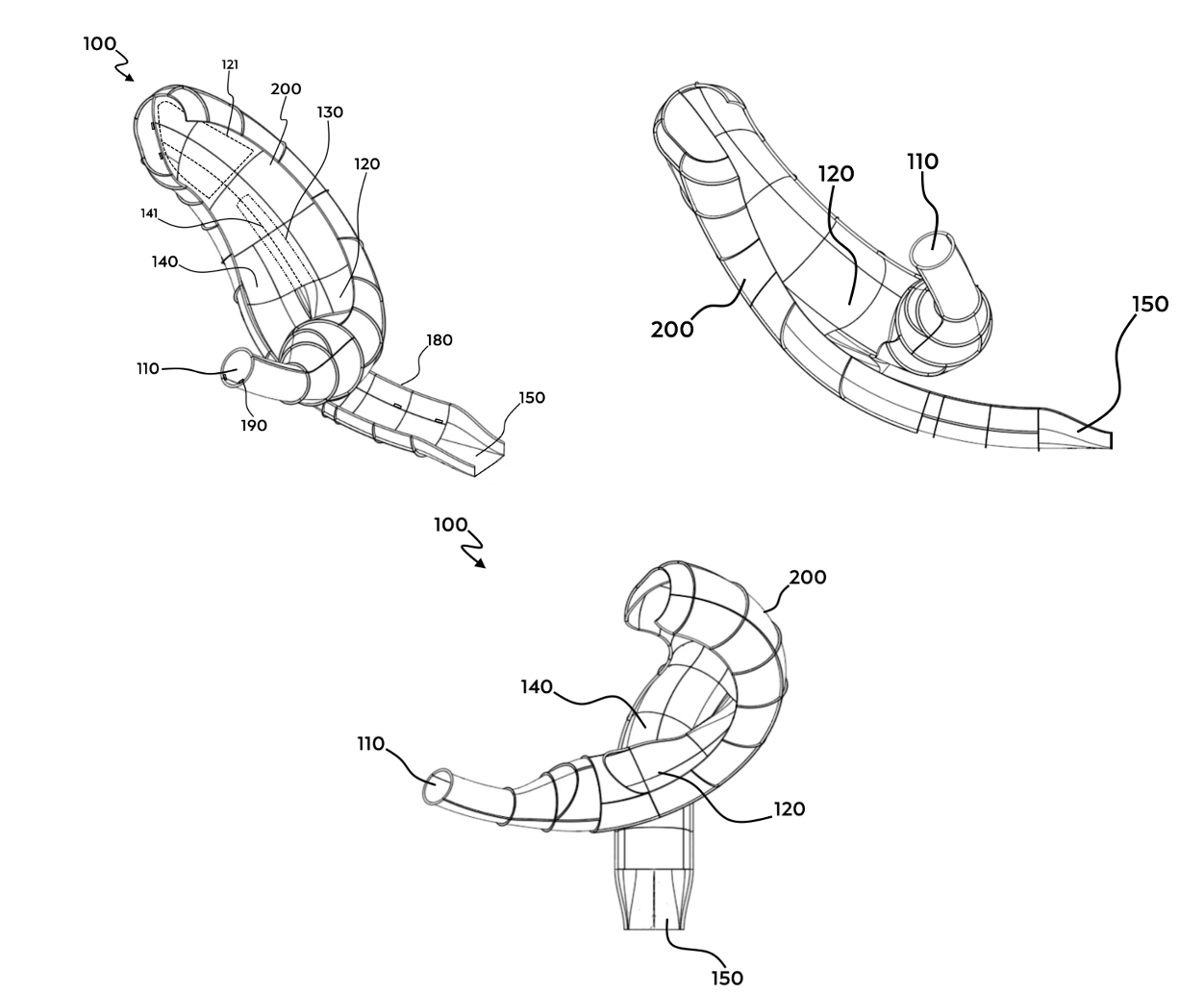
The dynamic analyses and user experience evaluations carried out have revealed that the Eclipse Water Slide exhibits results consistent with the design objectives in terms of kinematic behavior and flow dynamics. It has been observed that users’ path-following inside the bowl shows a high degree of conformity with the predicted trajectories, and that guidance stability is achieved in both sliding phases.
Tests performed under variable user masses (in the range of 50–150 kg) have demonstrated the kinematic consistency of the system. It has been determined that, for users of different masses, the velocity values in the energy dissipation zone (121) remain below 0.5 m/s, and that the change of direction in the transition region (130) occurs in a stable manner. This situation confirms the decisive role of geometric parameters (slope distribution, direction-reversal line, turning radii) on energy management and trajectory control.
In addition, it has been observed that the continuity of the water film is maintained and that hydrodynamic friction is balanced at a level sufficient to provide a consistent sliding experience regardless of mass. The results show that the system is minimally affected by flow-rate variations and exhibits a repeatable kinematic profile.
Hydromechanical Sizing and Inlet Velocity
Design Approach and Fundamental Principles:
The hydromechanical sizing of the system has been carried out based on the speed–path profiles obtained from multibody dynamic analyses and the safety criteria of the TS EN 1069 standard. In the design process, architectural layout constraints (inlet elevation, line clearances, platform relationships) have been taken into account, and it has been adopted as a principle that the inlet velocity (v₀) be defined as the main design parameter. This approach has ensured that flow conditions are optimized not only with hydraulic data but also together with the velocity window required by user kinematics.
Inlet Velocity Determination and Safety Criteria:
The target velocity range at the inlet has been determined by considering the minimum velocity required to ensure stable trajectory tracking inside the bowl and the maximum speed and acceleration limits permitted by the TS EN 1069 standard. By also taking into account sustainable film-flow conditions under operator settings, the inlet velocity window has been narrowed and standard compliance has been guaranteed.
Flow Rate–Velocity Relationship and Nozzle Design
After the target v₀ value was determined, a flow rate–velocity (Q–v) matching was carried out depending on the inlet cross-section and distribution geometry. The number of nozzles, their diameters and angular placements were optimized to generate a tangential swirl component into the bowl, and at the same time were sized to limit excessive spraying and splashing in the inlet region. The supply lines and valving system were staged so as to maintain film continuity under different flow regimes.
Hydraulic System and Energy Efficiency:
Installation losses (suction–discharge lines, fittings and local losses) have been evaluated through hydraulic calculations, and pump selection has been made taking these losses into account. For variable user densities and operating modes, a combination of frequency-inverter drive and valving has been envisaged, thereby optimizing energy consumption while maintaining the target v₀.
Sensitivity Analysis and Operational Stability:
Sensitivity analyses have been carried out for inlet velocity and in-bowl trajectory tracking under user mass distribution and operator-induced flow-rate variations. The continuity of film flow, overflow/splash risks and guidance stability have been evaluated using dedicated metrics, and these analyses have ensured the verification of the integration between dynamic analysis and the hydromechanical system.
Performance and Capacity Relationship
The effects of the selected v₀ range on station cycle times and flow continuity have been tested, and its conformity with the capacity targets of 240 persons/hour for single-raft operation and 480 persons/hour for double-raft operation has been confirmed. These results have shown that inlet velocity optimization satisfies not only safety requirements but also the operational capacity targets.
Safety and Standard Compliance:
The speed and acceleration values obtained from the experimental measurements and numerical analyses carried out have been compared with the safety limit values specified in the TS EN 1069-1/2 standards. The results have shown that the design meets all speed, acceleration and jerk criteria stipulated by the standards, and that “full standard compliance,” one of the project’s key success criteria, has been achieved.
Capacity and Operational Efficiency:
In line with station cycle times and continuous flow analyses, the capacity performance of the system has been evaluated. The analysis results have confirmed that the design has been optimized to meet the capacity targets of 240 persons/hour for single-raft use and 480 persons/hour for double-raft use. These findings demonstrate that the product is suitable for operations with high user volumes.
Production Optimization and Cost Effectiveness:
In the production process, existing slide molds have been utilized strategically, thereby minimizing new mold investment costs. This approach has provided a significant reduction in production costs per unit part, while also offering advantages in terms of supply chain and production continuity.
Innovative Design and User Experience:
The innovative aspect of the Eclipse slide has been demonstrated through the optimization of slope and curvature geometries together with speed and safety parameters. The differentiation of slopes on the first and second sliding surfaces has prevented a monotonous sliding experience by offering users variable speed profiles. In addition, improvements made to the direction and speed of water flow have made the sliding process more dynamic and exciting, while geometric speed control has ensured that safety standards are not compromised.
Economic, Promotional and Intellectual Property Impacts
Following completion of the project, it is planned to achieve a total of 10 sales within the first two years. Financial projections indicate that the break-even point, i.e., the payback period of the investment, will be reached in approximately 2.5 years.
For the purpose of promoting the product on the international stage and assessing its competitive strength in the sector, an application has been submitted to the IAAPA Expo Orlando – Brass Ring Awards “Best New Product Concept” competition. This prestigious participation is expected to enhance brand value and product visibility in the eyes of global water park operators and investors, thereby increasing the number of qualified request-for-proposal (RFP) inquiries.
In order to protect intellectual and industrial property rights, an international patent application has been filed for the invention under the PCT framework. In addition, the original design of the Eclipse water slide has been registered, and these steps are intended to increase the product’s bargaining power, create licensing opportunities, and reduce the risk of imitation.
Providing a strategic contribution to the product portfolio, Eclipse strengthens the existing range of self-themed raft slide products. In this way, through package solutions that can be offered together with high value-added tower and theme park products, it is anticipated that both the average value per customer and overall business volume will increase.
In order to measure the effectiveness of promotional activities and optimize marketing strategies, a multi-channel promotional matrix has been established, including IAAPA presentations, on-site demonstration videos, and digital campaigns. By regularly monitoring the number of proposals obtained after trade shows, conversion rates, average proposal values, and average sales closing times, marketing and sales processes will be improved and the break-even period will be optimized.
This study reveals that the geometry-based design approach implemented in the Eclipse dual-phase bowl-type water slide provides significant advantages in terms of safety, capacity, comfort, and resource efficiency by eliminating dependence on increasing flow rate for flow control. The configuration of slope (θ), curvature (κ), and banking (b) distributions within a continuous geometric integrity, together with the maintenance of a thin-film flow regime, has enabled the system to preserve the target speed band even under low flow rate (Q) and low head (H) conditions. This situation carries the potential to reduce specific energy consumption during operation compared to conventional “pump-centered” solutions.
In terms of water and energy efficiency, two fundamental components come to the fore: the continuity of the surface and the quality of the joints limiting splash and aerosol losses; and the distributed nozzle arrangement reducing local film thickness fluctuations and overflow risk. These effects carry the potential to balance water consumption in the recirculation system and the filtration/chemical load. Monitoring operating performance with kWh/ride and L/ride metrics will contribute to making these gains measurable and manageable at the facility scale.
The dual-phase kinematic structure of Eclipse offers a predictable and repeatable speed profile through controlled energy dissipation in the first phase and re-acceleration in the second phase. This profile reduces the need for external braking equipment while facilitating compliance with the speed and acceleration limits of the EN 1069-1/-2 standard. As a result, safety and capacity targets can be achieved with lower resource use; and reduced sensitivity to flow-rate fluctuations supports operational continuity by minimizing maintenance needs and downtime.
At the manufacturing and life-cycle scale, the RTM (Resin Transfer Molding)-based modular composite structure enhances film continuity in terms of surface roughness and joint geometry, while flanged connections also allow rapid maintenance and part replacement. This situation carries the potential to have an improving effect not only on initial investment costs but also on total cost of ownership over the entire life cycle.
The reflections of the study on design practice can be summarized under three main headings:
1. Geometry-Based Control: The integrated optimization of slope (θ), curvature (κ), and banking (b) functions makes it possible to maintain the target speed band with low flow rate and head.
2. Nozzle and Surface Optimization: The distributed feed configuration and refined transition radii increase recirculation efficiency by limiting splash and overflow losses.
3. Standard Compliance and Operational Efficiency: The dual-phase kinematic structure provides high-capacity line operation while simplifying the EN 1069 compliance process through stable exit speeds.
The evaluations within the scope of the study are limited to specific water temperature ranges, defined flow-rate/head conditions, and single-ride scenarios. The validity of the thin-film assumption has been ensured for certain Reynolds and Froude numbers; detailed sensitivity analyses for multi-ride scenarios and different user profiles (age, mass, posture) require additional studies. Moreover, calibration errors that may arise from the measurement infrastructure (IMU, video-based systems) and variabilities in field conditions have also been taken into account.
Within the scope of future studies, it is planned to quantitatively validate the kWh/ride and L/ride metrics with long-term field monitoring data; to implement real-time speed/acceleration calibration based on IMU and image processing; to perform parametric geometry optimization for different user profiles and multi-ride scenarios; and to integrate digital-twin-based operational simulations with energy and water budgets. In addition, it is aimed to reveal the environmental and economic impacts of efficiency gains in a holistic manner through Life Cycle Assessment (LCA) and Life Cycle Cost (LCC) analyses.
In the context of commercialization and innovation validation, Eclipse’s original geometric approach and modular composite architecture are protected by a PCT international patent application; participation in the IAAPA Orlando “Best New Product Concept” competition constitutes independent confirmation of the product’s level of innovation.
In conclusion, the Eclipse water slide presents an R&D innovation that consumes less water and energy for the same level of safety and user experience, is less sensitive to flow-rate variations, and exhibits repeatable performance in the field. Within this framework, it is expected to provide scalable contributions in the water park sector toward reducing energy costs, shrinking the water footprint, and ensuring sustainable standard compliance.
We would like to express our sincere gratitude to the entire Polgün Waterparks & Attractions team for their valuable contributions to this study.
References
- 1.[1] H. Anonymous, “Wet ’n’ Wild Orlando: The waterpark that made waves in the industry,” Park World Online, Mar. 8, 2020. [Online]. Available: https://www.parkworldonline.com/wet-n-wild-orlando-the-waterpark-that-made-waves-in-the-industry.
- 2.[2] H. Algül and S. Önder, “Design and planning principles of aquaparks (water parks) and evaluation of sample aquaparks in our country,” Selçuk University Journal of the Faculty of Agriculture, vol. 22, no. 45, pp. 105–111, 2008.
- 3.[3] J. Kahvecioğlu and C. Topaloğlu, “Products produced by water park and water slide manufacturers for children for hotel enterprises: The Polgün case,” Sivas Interdisciplinary Tourism Research Journal, no. 2, pp. 67–81, 2018.