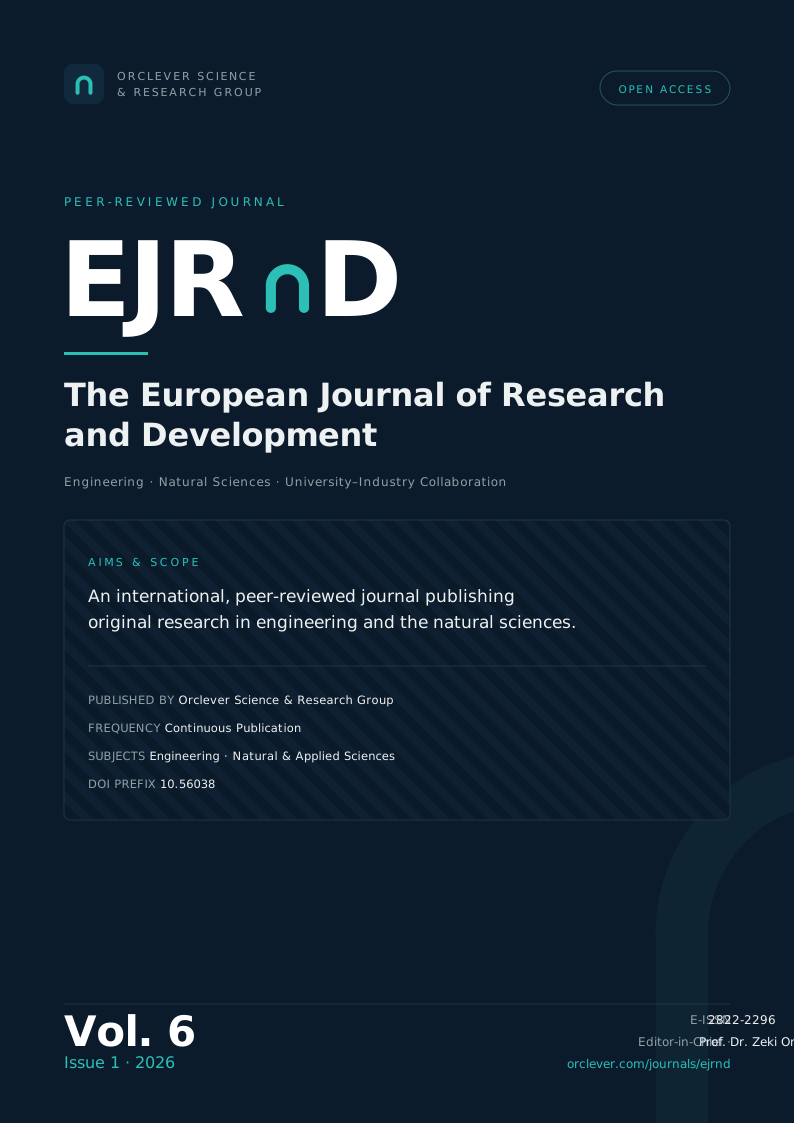
The European Journal of Research and Development
The European Journal of Research and Development (EJRnD) is a specialized, peer-reviewed scientific journal, published online
Impact Factor
-
Acceptance Rate
%27.46
Avg. Decision Time
23 days for 1st response
h-Index
7
Manuscript Preparation
The European Journal of Research and Development (EJRnD) uses a structured digital manuscript editor that allows authors to prepare their submissions directly within the journal’s online submission environment. The system is designed to simplify manuscript preparation by enabling authors to create, organize, and submit their work through a guided editorial interface rather than through manually formatted document files.
Under this model, authors can prepare the manuscript text, section headings, author information, abstracts, keywords, figures, tables, formulas, references, and required declarations directly within the submission system. The platform then automatically applies the journal’s publishing format and production structure. As a result, authors are not expected to manually adjust fonts, margins, spacing, layout settings, or journal-specific page formatting during manuscript preparation.
The purpose of this model is to reduce technical formatting burdens and allow authors to focus on the scientific quality, clarity, and completeness of their work.
1. General Preparation Principle
Authors should prepare manuscripts with attention to content quality rather than document styling. Because the journal’s system automatically structures and formats the article for publication, the responsibility of the author is to ensure that the manuscript is:
scientifically sound,
logically structured,
complete in all required sections,
clearly written in academic English,
accurate in its data, figures, formulas, and references,
and fully compliant with the journal’s ethical and editorial requirements.
Automatic formatting does not replace scholarly responsibility. The journal’s digital system standardizes presentation, but authors remain fully responsible for the integrity and quality of the submitted content.
2. Preparation Through the Structured Editor
The EJRnD submission environment enables authors to prepare their manuscripts within the platform using structured content fields and editorial blocks. Depending on the article type, authors may enter and organize the following components directly in the system:
manuscript title,
abstract,
keywords,
author names,
institutional affiliations,
corresponding author details,
ORCID information where available,
main body text,
section and subsection headings,
tables and table titles,
figures and figure captions,
equations and mathematical expressions,
acknowledgements,
funding information,
conflict of interest disclosure,
ethics approval statement where required,
data availability statement where relevant,
references,
and supplementary files where applicable.
This structure is intended to support submission consistency, improve metadata quality, and facilitate the journal’s editorial and production workflow.
3. What Authors Do Not Need to Do
Because the journal platform automatically converts the manuscript into the journal’s publication style, authors do not need to manually prepare the article according to traditional formatting instructions such as:
font family selection,
font size adjustment,
line spacing,
page margins,
manual heading design,
column arrangement,
page numbering,
or journal-specific visual layout.
Authors should therefore avoid spending time on cosmetic formatting and instead prioritize scientific clarity, structural completeness, and accurate content entry.
4. What Authors Must Prepare Carefully
Even though the system manages formatting automatically, authors must still prepare the intellectual and structural content of the manuscript carefully. In particular, authors must ensure that:
the title accurately reflects the content of the study,
the abstract summarizes the study clearly and precisely,
the keywords are relevant and searchable,
section headings are used consistently and logically,
the manuscript presents a coherent academic flow,
all figures and tables are complete and correctly labeled,
all formulas are accurate and readable,
references are complete and reliable,
all required declarations are included,
and the language is suitable for international scholarly readership.
The system assists with presentation, but the substance of the article must be fully prepared by the authors.
5. Recommended Manuscript Structure
For most Original Research Articles, authors are expected to prepare the manuscript in a structured academic form that typically includes the following elements:
Title
Abstract
Keywords
Introduction
Materials and Methods / Methodology
Results
Discussion
Conclusion
Acknowledgements, where applicable
Funding Statement
Conflict of Interest Statement
Ethics Statement, where applicable
Data Availability Statement, where relevant
References
For Review Articles, the structure may differ depending on the subject and method of review, but the manuscript should still follow a coherent and academically rigorous organization. Review Articles should generally include:
Title
Abstract
Keywords
Introduction
Clearly organized review sections
Critical evaluation of the literature
Conclusions and future directions
References
Authors should choose a structure appropriate to the article type and ensure that each section fulfills a clear scholarly purpose.
6. Title, Abstract, and Keywords
Title
The title should be concise, specific, and informative. It should accurately represent the main subject, method, or contribution of the manuscript.
Abstract
The abstract should provide a clear summary of the study. For research articles, it should typically indicate the purpose of the work, the approach or methodology used, the principal findings, and the significance of the results. The abstract should be understandable on its own and should not rely on unexplained abbreviations or excessive background detail.
Keywords
Keywords should reflect the main concepts, methods, or application areas of the study. They should help identify the article accurately in digital search environments and should be selected carefully.
7. Author Information and Affiliations
All author details must be entered accurately into the system. Authors should carefully review:
full author names,
institutional affiliations,
department or unit information where relevant,
country details,
corresponding author information,
email address,
and ORCID identifiers where applicable.
The corresponding author is responsible for ensuring that all listed authors have approved the submission and that the order of authors is final at the time of submission.
8. Tables, Figures, and Visual Materials
The structured editor allows authors to insert and organize tables and figures directly within the manuscript workflow. These elements should be submitted in a publication-ready scholarly form.
Tables
Tables should be clear, readable, and necessary for the understanding of the manuscript. Each table should have a concise title and should be referred to appropriately in the text.
Figures
Figures should be relevant, legible, and properly labeled. Each figure should be accompanied by a descriptive caption that explains its content sufficiently.
Graphs, Schematics, and Images
Any visual material included in the manuscript should be academically justified, technically clear, and suitable for interpretation by reviewers and readers.
Authors are responsible for ensuring the scientific and visual accuracy of all non-text elements.
9. Equations and Mathematical Expressions
The submission system supports the direct entry of equations and mathematical expressions within the editor. Authors may use the available formula tools to include mathematical content in a structured and readable form.
All equations should be checked carefully before submission to ensure:
correctness of notation,
consistency of symbols,
completeness of expressions,
and proper relation to the surrounding text.
The journal system may standardize the appearance of mathematical material during production, but the author remains fully responsible for the correctness of the content.
10. References and Citations
References must be complete, accurate, and relevant to the manuscript. Authors should ensure that all sources cited in the text are included in the reference list and that all entries are bibliographically correct.
Authors should avoid:
incomplete references,
broken citation links,
excessive self-citation,
irrelevant references,
citation manipulation,
and overreliance on non-scholarly sources.
Where the system supports structured reference entry, authors should use it carefully and verify all bibliographic details before final submission.
11. Language and Clarity
All manuscripts must be written in clear academic English. Authors are responsible for ensuring that the manuscript is grammatically correct, stylistically coherent, and understandable to an international scholarly audience.
If language quality is insufficient for peer review or editorial assessment, the manuscript may be returned for improvement before further consideration.
12. Required Declarations
During manuscript preparation, authors must provide all declarations required by the journal. Depending on the nature of the submission, these may include:
originality statement,
authorship confirmation,
conflict of interest disclosure,
funding information,
ethics committee approval details,
informed consent statement where required,
data availability statement,
acknowledgement of assistance or support,
and disclosure of any material use of generative AI tools where relevant.
These statements are an essential part of responsible scholarly publishing and should be completed accurately and transparently. Public clarity on such policies is consistent with recognized best-practice expectations in scholarly publishing.
13. Supplementary Materials
Where relevant, authors may submit supplementary materials to support the main article. Such materials may include additional datasets, appendices, technical files, extended figures or tables, or other supporting content.
Supplementary materials should be clearly identified, directly relevant to the manuscript, and submitted in a form suitable for editorial handling and online presentation.
14. Pre-Submission Check by Authors
Before final submission, authors should review the manuscript carefully and confirm that:
the submission fits the aims and scope of the journal,
the selected article type is correct,
all required sections are complete,
all figures, tables, and formulas are included correctly,
all author details are accurate,
all declarations are completed,
references are checked,
the manuscript is written in clear English,
and the content is ready for editorial evaluation.
The journal encourages authors to perform this review carefully before completing submission through the platform.
15. Content-First Preparation Philosophy
EJRnD adopts a content-first manuscript preparation model. The journal’s digital submission infrastructure is designed to remove unnecessary formatting barriers and to make scholarly submission more efficient, more structured, and more consistent.
This means that authors should focus primarily on:
originality,
scientific contribution,
methodological rigor,
clarity of reporting,
quality of data presentation,
transparency of declarations,
and overall coherence of the manuscript.
By reducing the technical burden of formatting, the journal aims to create a more author-friendly submission experience while preserving editorial quality, consistency, and publication integrity.
Final Note
The manuscript preparation stage at EJRnD is designed to support efficient, accurate, and professionally structured scholarly submission. Authors are encouraged to use the journal’s digital editor carefully and to prepare their manuscripts with attention to scientific quality, structural completeness, and editorial compliance. The journal’s automated formatting system is intended to simplify technical preparation, but the responsibility for the academic content of the manuscript remains entirely with the authors.