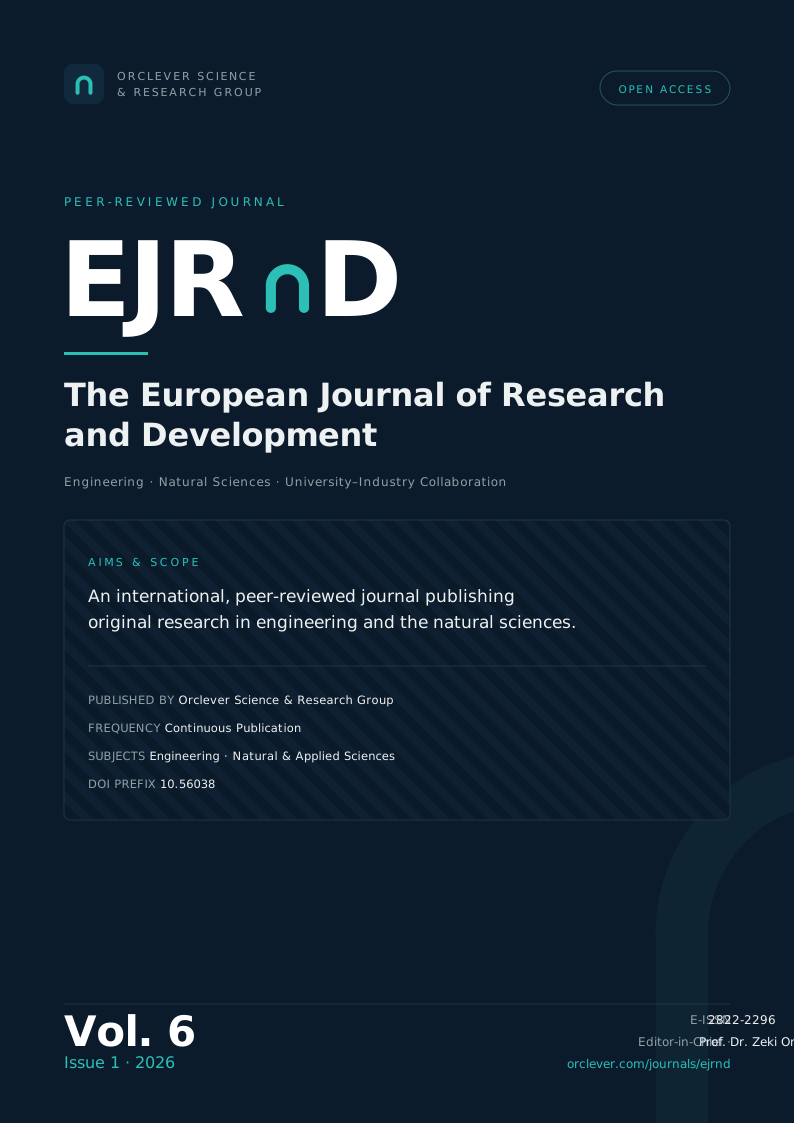
The European Journal of Research and Development
The European Journal of Research and Development (EJRnD) is a specialized, peer-reviewed scientific journal, published online
Impact Factor
-
Acceptance Rate
%27.46
Avg. Decision Time
23 days for 1st response
h-Index
7
Plagiarism Policy
Plagiarism definition, screening process, author responsibilities, and consequences
The European Journal of Research and Development (EJRnD) is committed to upholding the highest standards of academic integrity and publication ethics. Plagiarism in any form is considered a serious breach of scholarly conduct and is strictly prohibited. This policy outlines the journal's procedures for detecting, investigating, and responding to cases of plagiarism in accordance with the guidelines of the Committee on Publication Ethics (COPE).
Definition of Plagiarism
Plagiarism is the appropriation of another person's ideas, processes, results, or words without giving appropriate credit. EJRnD recognises the following as forms of plagiarism:
Direct plagiarism: Verbatim copying of text, figures, tables, or data from another source without quotation marks or citation.
Mosaic (patchwork) plagiarism: Combining paraphrased passages from multiple sources without proper attribution.
Self-plagiarism (text recycling): Reusing substantial portions of the author's own previously published work without disclosure and citation.
Inadequate attribution: Citing a source incompletely, inaccurately, or in a manner that misleads the reader about the originality of the work.
Image, figure, and data plagiarism: Reproducing visual materials or datasets from other sources without permission and attribution.
Screening Procedure
All manuscripts submitted to EJRnD are screened for textual similarity using iThenticate / Turnitin plagiarism detection software at two stages: (1) during the initial editorial screening, before the manuscript is sent for peer review, and (2) after acceptance, prior to final production. The journal applies the following thresholds:
Overall similarity index must not exceed 20%, excluding references, standard methodology descriptions, and properly cited quotations.
Similarity from any single source must not exceed 3%.
Manuscripts exceeding these thresholds are either returned to the authors for revision with a detailed similarity report, or rejected outright, depending on the nature and extent of the overlap.
Author Responsibilities
By submitting a manuscript to EJRnD, all authors warrant that:
The work is original and has not been published elsewhere, in whole or in part, in any language.
The manuscript is not currently under consideration by any other journal.
All sources — including the authors' own prior publications — are properly cited and attributed.
Required permissions have been obtained for the reproduction of any copyrighted figures, tables, or extended quotations.
All listed authors have made a substantial contribution to the work and have approved the final version for submission.
The use of any artificial intelligence tools in the preparation of the manuscript has been disclosed.
Investigation of Suspected Plagiarism
Where plagiarism is suspected — whether detected during screening, identified by reviewers, or reported after publication — EJRnD follows the COPE flowcharts for handling such cases. The procedure includes:
Initial assessment of the evidence by the Editor-in-Chief.
Formal written request for explanation from the corresponding author, who is expected to respond within 30 days.
Independent review of the author's response and the evidence by the editorial board.
Consultation with the author's institution, where the severity of the case warrants such action.
A final decision communicated in writing to all relevant parties.
Consequences of Confirmed Plagiarism
Depending on the severity, confirmed cases of plagiarism may result in one or more of the following actions:
Immediate rejection of the manuscript at any stage of the editorial process.
Retraction of the published article, accompanied by a formal retraction notice linked to the original publication and indexed databases.
Notification of the author's affiliated institution and, where applicable, funding bodies.
Prohibition on future submissions to EJRnD for a period of up to five years.
Reporting of the incident to COPE and to the indexing services in which EJRnD is listed.
Appeals and Reporting
Authors who wish to appeal a plagiarism decision may submit a written appeal to the Editor-in-Chief within 30 days of the decision, providing a detailed rebuttal. Readers or third parties who wish to report a suspected case of plagiarism — whether in a submitted or already published article — are encouraged to contact the Editor-in-Chief. All reports are handled confidentially and investigated in accordance with COPE guidelines.
This policy is reviewed annually and updated as necessary to reflect evolving best practices in publication ethics.