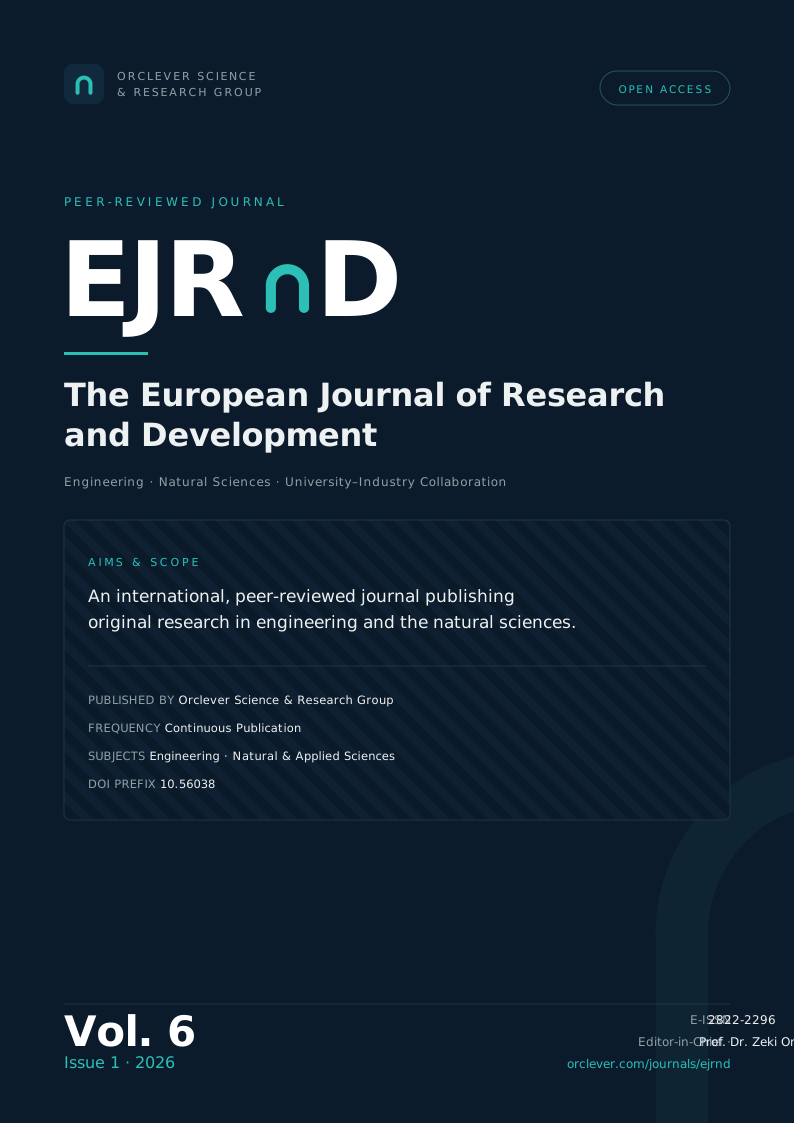
The European Journal of Research and Development
The European Journal of Research and Development (EJRnD) is a specialized, peer-reviewed scientific journal, published online
Impact Factor
-
Acceptance Rate
%27.46
Avg. Decision Time
23 days for 1st response
h-Index
7
Aims & Scope
Journal objectives, coverage areas, and target audience
The European Journal of Research and Development (EJRnD) is an international, peer-reviewed scholarly journal committed to publishing high-quality research in engineering, technology, and the natural sciences. The journal aims to advance scientific knowledge and research-driven innovation by providing a rigorous academic platform for the dissemination of original, methodologically sound, and practically relevant studies.
EJRnD seeks to publish research that contributes not only to the academic literature but also to technological development, industrial practice, and societal progress. In line with this mission, the journal particularly values manuscripts that demonstrate scientific originality, analytical depth, methodological rigor, and clear relevance to contemporary research and development challenges.
A distinctive academic orientation of the journal is its emphasis on the connection between scientific inquiry and practical application. EJRnD encourages submissions that support innovation, strengthen university–industry collaboration, and transform theoretical knowledge into applicable scientific, technological, or industrial outcomes.
Scope of the Journal
The journal welcomes submissions from a broad range of disciplines within engineering, technology, and the natural sciences. Contributions may be theoretical, experimental, computational, methodological, or application-oriented, provided that they offer a clear scholarly contribution and remain aligned with the editorial focus of the journal.
EJRnD particularly welcomes manuscripts in, but not limited to, the following fields:
Electrical, Electronics, and Communication Engineering
This area includes research on power systems, smart grids, electronics, embedded systems, signal and image processing, communication technologies, control systems, instrumentation, automation, and related engineering applications.
Computer Science, Artificial Intelligence, and Software Technologies
This area includes research on artificial intelligence, machine learning, deep learning, data science, computer vision, software engineering, cybersecurity, intelligent systems, optimization methods, quantum computing, and advanced computational approaches.
Mechanical, Mechatronics, and Industrial Engineering
This area includes research on robotics, automation, advanced manufacturing, production systems, thermodynamics, fluid mechanics, industrial systems design, operations and decision sciences, supply chain systems, and engineering management applications.
Materials Science and Nanotechnology
This area includes research on smart materials, biomaterials, nanomaterials, nanocomposites, material characterization, metallurgy, structural analysis, functional materials, and material performance in engineering applications.
Sustainable Energy and Environmental Engineering
This area includes research on renewable energy systems, clean technologies, energy efficiency, energy storage, waste management, environmental modeling, sustainability-focused engineering solutions, and green transformation processes.
Applied Physics and Engineering Mathematics
This area includes research on applied physics, computational physics, mathematical modeling, simulation, numerical methods, applied electromagnetics, operations research, optimization, and statistical methods in engineering and scientific research.
Interdisciplinary Research
Interdisciplinary and multidisciplinary submissions are strongly encouraged, particularly where they address complex scientific or technological problems through integrated approaches. Manuscripts that combine multiple fields are welcome, provided that they present a coherent scientific framework, demonstrate methodological robustness, and make a clear contribution to research and development.
Article Types
EJRnD considers the following categories of manuscripts:
Original Research Articles
Original Research Articles should present novel findings, innovative methods, experimental results, analytical frameworks, computational models, or technological developments that contribute meaningfully to the advancement of the relevant field.
Review Articles
Review Articles should provide a comprehensive, critical, and well-structured evaluation of a specific scientific or technological topic. Such manuscripts are expected to synthesize the literature in depth, identify current trends and research gaps, and propose directions for future investigation. Reviews should be supported by a substantial and up-to-date body of scholarly sources.
Publication Language and Originality
The publication language of EJRnD is English. Submitted manuscripts must be written in clear and academically appropriate English to ensure accessibility for an international readership.
Manuscripts submitted to the journal must be original and must not have been previously published or be under consideration for publication elsewhere. Submissions are expected to comply with the journal’s ethical and editorial standards, including requirements related to originality, authorship responsibility, research integrity, and proper scholarly conduct.
Evaluation Principles
All submissions are assessed in terms of their relevance to the journal’s scope, originality, scientific contribution, methodological validity, clarity of presentation, and overall academic quality. Manuscripts that fall outside the editorial focus of the journal, lack sufficient scholarly contribution, or fail to meet the journal’s academic and ethical expectations may be declined during editorial evaluation.
Mission-Oriented Closing Statement
Through its editorial scope, EJRnD aims to serve as a reliable academic venue for the publication of research that supports innovation, scientific development, interdisciplinary collaboration, and the advancement of research and development practices at national and international levels.