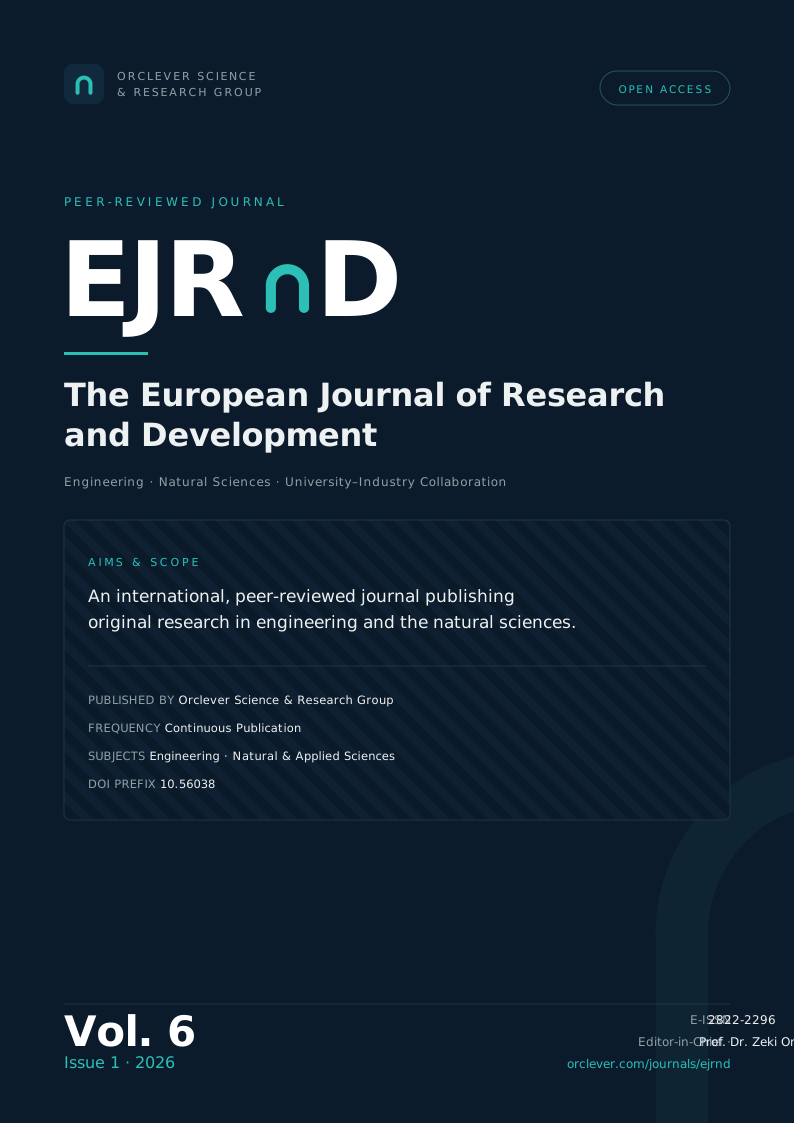
The European Journal of Research and Development
The European Journal of Research and Development (EJRnD) is a specialized, peer-reviewed scientific journal, published online
Impact Factor
-
Acceptance Rate
%27.46
Avg. Decision Time
23 days for 1st response
h-Index
7
For Authors
Author guidelines, manuscript preparation, and submission instructions
The European Journal of Research and Development (EJRnD) welcomes the submission of original and high-quality scholarly work in engineering, technology, and the natural sciences. Authors are invited to submit manuscripts that are scientifically rigorous, methodologically sound, ethically compliant, and clearly relevant to the aims and scope of the journal.
EJRnD uses a structured online submission and manuscript editor system. Unlike conventional submission models based on manually formatted word processor files, the journal’s submission environment allows authors to prepare and submit their manuscripts directly within the editorial platform. The system is designed to organize manuscript content, author information, figures, tables, equations, and references in a structured format and automatically convert accepted submissions into the journal’s publication style.
As a result, authors are not required to format manuscripts manually in accordance with journal typography, font, spacing, or layout rules at the submission stage. Instead, authors are expected to focus on the scientific quality, completeness, clarity, and structural accuracy of the manuscript content.
1. Scope and General Requirements
Before preparing a submission, authors should ensure that the manuscript falls within the aims and scope of EJRnD. Manuscripts must present original work and should contribute meaningfully to research, innovation, scientific understanding, or practical application within the journal’s editorial scope.
Submissions must:
be original and not previously published in substantially the same form,
not be under consideration by another journal at the time of submission,
be written in clear and academically appropriate English,
comply with the journal’s ethical and editorial standards,
present accurate, complete, and verifiable scholarly content.
The journal considers only manuscripts that demonstrate relevance to the journal, scientific merit, methodological soundness, and scholarly clarity.
2. Article Types
EJRnD accepts the following categories of manuscripts:
Original Research Articles
Original Research Articles should present novel findings, new methods, experimental results, computational models, analytical frameworks, or technological developments that make a clear scholarly contribution.
Review Articles
Review Articles should provide a critical and comprehensive synthesis of a defined research area. Reviews are expected to evaluate the literature analytically, identify research trends and gaps, and propose directions for future study.
The editorial office may decline submissions that do not fit the journal’s article categories or that do not meet the expected scholarly standard.
3. Structured Submission Environment
All manuscripts must be submitted through the journal’s official online submission system. The system is based on a structured manuscript editor, which enables authors to compose and organize the article directly within the platform.
Within this environment, authors may enter and manage:
article title and subtitle,
abstract and keywords,
author names and affiliations,
ORCID identifiers where applicable,
main manuscript text,
section headings and subsections,
tables,
figures and captions,
mathematical expressions and formulas,
acknowledgements,
funding statements,
conflict of interest declarations,
ethical approval statements where relevant,
references and citation metadata,
supplementary materials where applicable.
The platform is designed to apply the journal’s formatting and presentation style automatically. Accordingly, authors are not expected to spend time on page design, font selection, line spacing, manual heading styles, or journal-specific document layout during submission.
4. What Authors Are Responsible For
Although the system automates the journal’s visual and structural formatting, authors remain fully responsible for the academic and technical quality of the submitted content. Authors must ensure that:
the manuscript is complete and internally consistent,
section headings are used logically,
the title accurately reflects the content,
the abstract is informative and concise,
the keywords are relevant,
all authors and affiliations are entered correctly,
figures and tables are accurate and properly labeled,
formulas are entered correctly,
references are complete and reliable,
all required declarations are included,
the language is clear and suitable for international academic readership.
Automatic formatting does not replace editorial or scholarly responsibility. The quality of the published article depends fundamentally on the quality of the content submitted by the author.
5. Manuscript Structure
Authors should prepare their manuscripts in a clear academic structure appropriate to the article type. For most research articles, the journal expects the following core elements:
Title
Abstract
Keywords
Introduction
Materials and Methods / Methodology
Results
Discussion
Conclusion
Acknowledgements, if applicable
Funding Information
Conflict of Interest Statement
Ethics Statement, where required
Data Availability Statement, where relevant
References
Review Articles may follow a different internal organization depending on the nature of the topic, but they should still maintain a coherent scholarly structure, logical sectioning, and analytical clarity.
6. Title, Abstract, and Keywords
The title should be concise, informative, and academically precise. It should accurately reflect the main subject and contribution of the manuscript.
The abstract should provide a clear summary of the purpose, methodology, main findings, and significance of the study. It should be written as a standalone scholarly summary and should not contain unnecessary citations, unexplained abbreviations, or extensive background discussion.
Keywords should reflect the main scientific concepts, methods, or application areas of the study and should support discoverability.
7. Author Information
All author information must be entered accurately in the submission system. This includes:
full names of all authors,
institutional affiliations,
country information,
corresponding author details,
contact email,
ORCID identifiers where available.
The order of authors should be finalized before submission. Any post-submission changes in authorship may require editorial review and written confirmation from all listed authors.
8. Figures, Tables, and Equations
The structured manuscript editor supports the direct insertion of figures, tables, and mathematical content. Authors should ensure that all such materials are submitted in a clear, complete, and publication-ready academic form.
Figures
Figures must be relevant, clearly legible, properly numbered, and accompanied by descriptive captions. Authors are responsible for ensuring that all figure content is accurate and that image quality is adequate for publication.
Tables
Tables should be prepared in a structured and readable form. Each table must have a clear title and should be cited appropriately within the text.
Equations and Mathematical Expressions
Authors may enter formulas and equations directly within the system. Mathematical content should be checked carefully for completeness, correctness, symbol consistency, and readability.
The system may standardize the visual presentation of these elements, but authors remain responsible for their scientific accuracy.
9. References and Citations
Authors must ensure that all references are accurate, complete, and relevant to the manuscript. References should reflect the scholarly basis of the work and should be used responsibly.
Authors should avoid:
incomplete or incorrect bibliographic entries,
excessive self-citation,
irrelevant citation padding,
citation manipulation,
overreliance on non-scholarly sources.
The submission system may assist with structured reference entry, but authors must verify all bibliographic information before final submission.
10. Language Quality
All manuscripts must be submitted in English. Authors are responsible for ensuring that the manuscript is written in clear, grammatically correct, and academically appropriate language.
A submission may be returned for language improvement if the quality of writing prevents effective editorial evaluation or peer review. Language clarity is essential not only for readability but also for accurate scientific communication.
11. Ethical and Editorial Declarations
Authors must provide all declarations required by the journal during submission. Depending on the nature of the manuscript, these may include:
authorship confirmation,
originality confirmation,
conflict of interest disclosure,
funding disclosure,
ethics committee approval information,
informed consent statement where required,
data availability statement,
use of artificial intelligence tools where materially relevant,
acknowledgement of third-party support.
The journal expects authors to comply fully with its Publication Ethics and Editorial Policies. Transparent declarations are an important part of responsible scholarly publishing and align with international best-practice expectations for journal websites and editorial processes.
12. Submission Process
Authors should submit manuscripts only through the official journal platform. A typical submission includes:
entering article metadata,
entering or uploading manuscript content into the structured editor,
completing author details,
adding figures, tables, and equations,
entering references,
uploading any required supplementary files,
completing mandatory declarations,
reviewing the final submission record,
confirming and submitting the manuscript.
Before final submission, authors should carefully review all entered information to ensure completeness and accuracy.
13. Editorial Screening and Peer Review
All submissions are subject to an initial editorial assessment. At this stage, manuscripts may be evaluated for:
relevance to the journal’s scope,
originality,
academic quality,
ethical suitability,
language clarity,
completeness of submission materials.
Manuscripts that successfully pass editorial screening proceed to peer review in accordance with the journal’s review model. Clear public description of peer review and editorial procedures is one of the visible signals of editorial rigor in major journal evaluation frameworks.
14. Formatting Philosophy of the Journal
EJRnD adopts a content-first submission philosophy. The journal’s digital infrastructure is designed to reduce the technical burden on authors by automating journal-specific formatting and production styling. This means that authors are not expected to spend time manually adjusting document design elements such as font family, font size, heading style, spacing, pagination, or layout arrangement.
Instead, authors should concentrate on:
scientific originality,
methodological rigor,
completeness of reporting,
accuracy of data presentation,
clarity of figures and tables,
coherence of argument,
and compliance with ethical and editorial expectations.
This model is intended to make submission more efficient while preserving editorial control, publication consistency, and the professional quality of the final published article.
15. Revisions
If revision is requested, authors should respond to reviewer and editor comments carefully, respectfully, and comprehensively. Revised submissions should address all major points raised during evaluation. Authors may also be asked to provide a response document explaining how each comment was addressed.
The revised manuscript must remain consistent across all updated sections, including text, tables, figures, references, and declarations.
16. Post-Acceptance
After acceptance, manuscripts proceed through the journal’s post-acceptance workflow, which may include editorial checks, copyediting, proofreading, metadata verification, DOI assignment, and online publication preparation.
The journal’s automated publishing infrastructure helps ensure that accepted manuscripts are converted efficiently into the journal’s publication format while preserving consistency, readability, and bibliographic integrity.
17. Final Responsibility of Authors
By submitting to EJRnD, authors confirm that:
the manuscript is original,
the submission is ethically compliant,
all information provided is accurate,
all authors approve the submission,
the manuscript is suitable for peer review,
and the journal’s editorial and ethical policies have been read and accepted.
Authors are strongly encouraged to review all journal policies before submission, including those related to publication ethics, peer review, open access, copyright and licensing, archiving, and publication fees.
Manuscript template
Write your manuscript in the journal's Word template. It carries the paragraph styles the submission system reads, so your title, abstract, keywords, section headings and references land in the right fields when you upload the file — and it shows how to mark where each figure belongs. Figure files are uploaded separately, because charts and drawings do not come out of Word reliably.
Do not type author names, affiliations or ORCID iDs into the manuscript file — they are collected and verified during submission, and this file is what reviewers read.