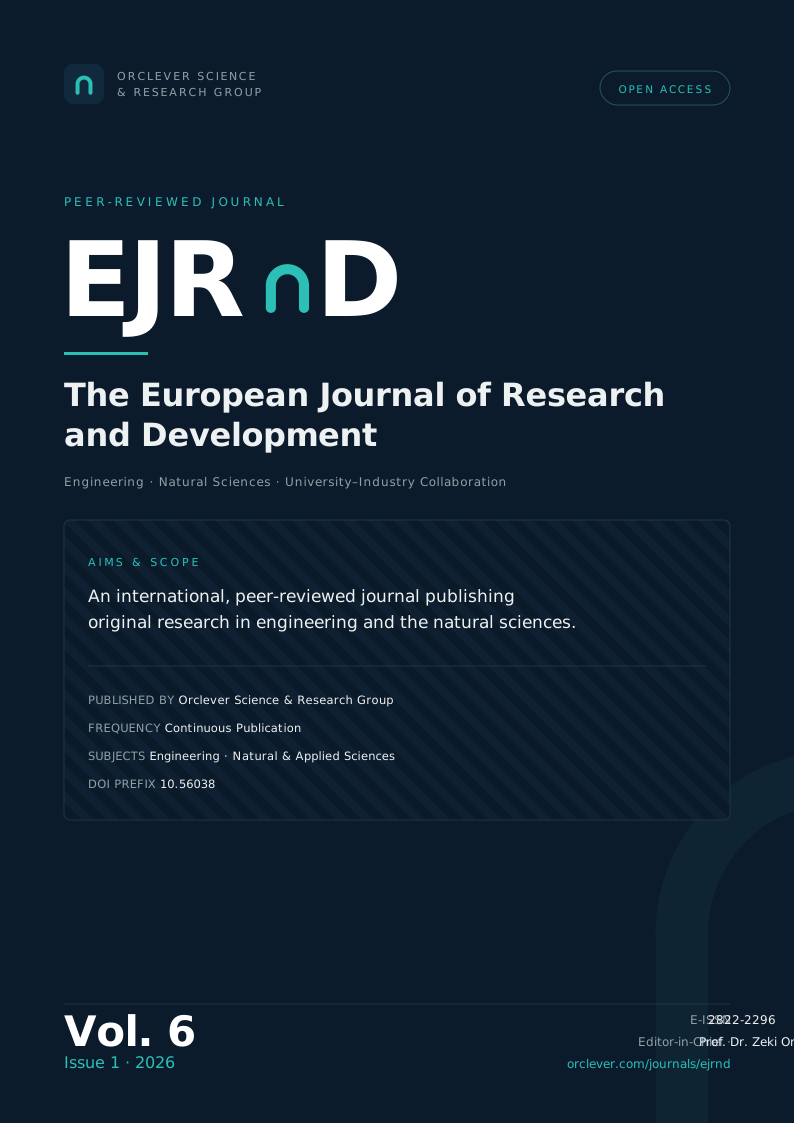
The European Journal of Research and Development
The European Journal of Research and Development (EJRnD) is a specialized, peer-reviewed scientific journal, published online
Impact Factor
-
Acceptance Rate
%27.46
Avg. Decision Time
23 days for 1st response
h-Index
7
Publication Model
Publication Model and Development
The European Journal of Research and Development (EJRnD) has followed a progressive and structured publication path since its establishment. The journal was launched as an annual publication in 2021, continued as a quarterly publication between 2022 and 2024, and transitioned to a continuous publication model in 2025. This development reflects the journal’s editorial maturation and its commitment to improving the speed, continuity, and efficiency of scholarly communication.
The evolution of EJRnD’s publication model has been shaped by the journal’s growing editorial capacity, increasing international visibility, and its objective of ensuring more timely access to peer-reviewed research. By moving from a fixed annual schedule to a more dynamic and responsive publishing framework, the journal aims to strengthen its role as a reliable academic platform for the dissemination of high-quality research in engineering, technology, and the natural sciences.
A clearly described and consistently implemented publication model is an important indicator of editorial reliability, operational transparency, and publishing maturity. For scholarly journals seeking inclusion in major international abstracting and indexing systems, the public presentation of a stable and coherent publication structure is essential.
Continuous Publication Model
Beginning in 2025, EJRnD adopted a continuous publication model in order to publish accepted articles more efficiently and without unnecessary delay. Under this model, articles are published individually as soon as they successfully complete the full editorial, peer review, revision, copyediting, proofreading, and production workflow.
The continuous publication model allows the journal to reduce the time between final acceptance and formal publication, thereby supporting faster communication of new scientific knowledge. This approach benefits authors by enabling earlier visibility of their work and benefits readers by providing more immediate access to current research findings.
At the same time, the adoption of continuous publication does not alter the journal’s commitment to editorial rigor. All manuscripts continue to undergo the same standards of editorial screening, peer review, ethical evaluation, and production control before publication. The model is designed to improve timeliness while fully preserving academic quality, editorial oversight, and the integrity of the scholarly record.
Editorial and Production Workflow
Within the continuous publication framework, submitted manuscripts proceed through the journal’s standard editorial workflow, including:
initial editorial assessment,
peer review,
author revision where required,
editorial decision,
copyediting and proofreading,
final production and online publication.
An article is published only after all editorial and production stages have been completed in accordance with the journal’s standards. This ensures that the speed of publication is balanced with scientific quality, methodological soundness, and publication integrity.
Advantages of the Publication Model
The current publication model of EJRnD offers several important advantages for scholarly communication. It supports:
timely publication of accepted research,
continuous dissemination of new scientific contributions,
greater visibility for authors and articles,
improved accessibility for readers,
better alignment with digital publishing environments, and
stronger editorial responsiveness to manuscript flow.
For journals aiming to strengthen their international academic presence, timeliness and consistency of publication are important strategic advantages when combined with transparent governance, clear editorial policies, and a rigorous peer review system.
Publication Record and Scholarly Continuity
Although EJRnD now follows a continuous publication model, the journal maintains its commitment to bibliographic order, publication traceability, and the integrity of the version of record. Published articles remain part of the journal’s formal scholarly archive and are presented through the journal’s digital platform in a structured and accessible manner.
This approach ensures that the journal combines the advantages of rapid digital publication with the stability and reliability expected in professional academic publishing. In this way, EJRnD seeks to maintain both operational efficiency and long-term scholarly credibility.
Final Statement
Through its publication model, EJRnD aims to support the rapid, transparent, and reliable communication of research. The transition from annual publication to quarterly publication, and ultimately to continuous publication, reflects the journal’s ongoing development and its commitment to improving the dissemination of high-quality scholarly work. By combining publication timeliness with editorial rigor and publication integrity, EJRnD continues to strengthen its publishing framework in line with the expectations of the international academic community.