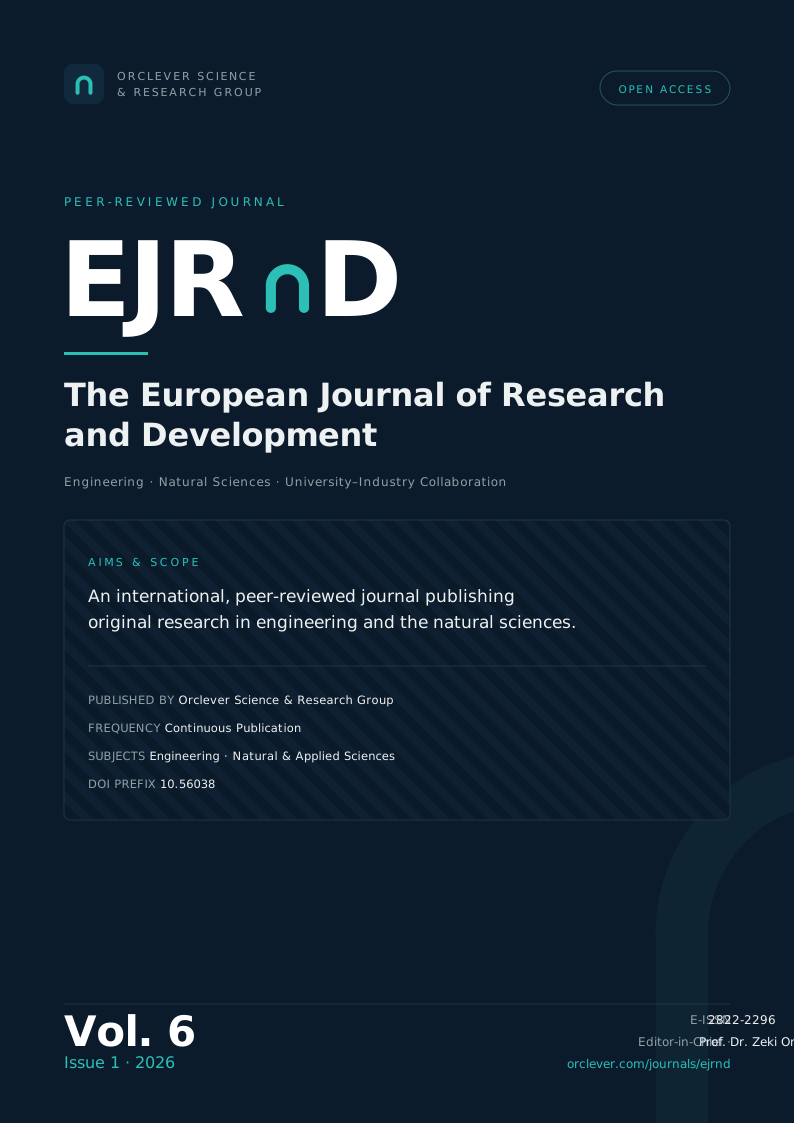
The European Journal of Research and Development
The European Journal of Research and Development (EJRnD) is a specialized, peer-reviewed scientific journal, published online
Impact Factor
-
Acceptance Rate
%27.46
Avg. Decision Time
23 days for 1st response
h-Index
7
Submission Guidelines
The European Journal of Research and Development (EJRnD) accepts manuscript submissions exclusively through its official online submission platform. The journal uses a structured digital manuscript editor designed to simplify the submission process and to enable authors to prepare, organize, and submit their work directly within the system.
Unlike conventional submission models based on manually formatted word processor files, the EJRnD submission platform allows authors to enter manuscript content, author details, figures, tables, equations, and references directly into the editorial environment. The system is designed to automatically organize and convert accepted submissions into the journal’s publication format. Accordingly, authors are not expected to prepare manuscripts according to manual layout or formatting rules before submission.
The submission process is intended to be efficient, transparent, and user-friendly while maintaining the journal’s editorial and academic standards.
1. Before You Submit
Before starting a submission, authors should ensure that:
the manuscript falls within the aims and scope of the journal,
the selected article type is appropriate,
the manuscript is original and not under consideration elsewhere,
all authors have approved the submission,
the content is written in clear academic English,
all required declarations and supporting information are ready,
and the manuscript is suitable for editorial evaluation and peer review.
Authors are strongly encouraged to review the journal’s relevant pages before submission, including Instructions for Authors, Article Types, Manuscript Preparation, and Publication Ethics and Editorial Policies.
2. Submission Through the Online Platform
All manuscripts must be submitted through the journal’s official online system. The system provides a guided submission environment in which authors can create and complete a submission step by step.
A typical submission includes the following stages:
entering manuscript metadata,
selecting the article type,
providing author and affiliation details,
entering the title, abstract, and keywords,
preparing or pasting the main manuscript text into the structured editor,
adding figures, tables, and equations,
entering references,
completing required declarations,
uploading supplementary files where applicable,
reviewing the complete submission,
and confirming final submission.
The journal does not accept submissions by email or through unofficial channels.
3. Author Registration and Account Access
To submit a manuscript, the corresponding author must register in the journal’s submission system and create an active user account. Authors should ensure that their account information is accurate and up to date, especially their name, affiliation, email address, and contact details.
The corresponding author will serve as the main communication contact throughout the editorial and review process unless otherwise specified.
4. Selecting the Appropriate Article Type
During submission, authors must select the article type that best matches the manuscript. EJRnD currently considers submissions in the following categories:
Original Research Articles
Review Articles
The selected category should accurately reflect the nature, purpose, and structure of the manuscript. If a submission is entered under an inappropriate category, the editorial office may request correction or may return the submission for resubmission under the correct type.
5. Entering Manuscript Information
Authors are required to enter complete and accurate manuscript information into the system. This typically includes:
manuscript title,
abstract,
keywords,
article type,
author names,
institutional affiliations,
corresponding author information,
ORCID identifiers where available,
and other required metadata.
This information should be reviewed carefully before final submission, as it forms part of the manuscript’s editorial record and publication metadata.
6. Preparing the Manuscript in the Editor
The journal’s structured submission editor enables authors to prepare the manuscript directly within the system. Authors may enter or organize:
the full text of the article,
section headings and subsections,
tables and titles,
figures and captions,
equations and mathematical expressions,
acknowledgements,
declarations,
references,
and supplementary notes.
Because the journal system applies formatting automatically, authors do not need to manually prepare the manuscript according to layout requirements such as font size, margins, spacing, or page design. Authors should instead focus on clarity, completeness, and scientific quality.
7. Uploading or Adding Supporting Materials
Where necessary, authors may be asked to upload or provide additional supporting materials. These may include:
supplementary files,
data-related materials,
figure files,
permission documents,
ethics approval documentation,
response files during revision,
or other editorially required materials.
Any supplementary material should be clearly labeled and directly relevant to the manuscript.
8. Required Declarations During Submission
The submission system may require authors to complete one or more declarations before the manuscript can be formally submitted. Depending on the article and study type, these may include:
originality confirmation,
authorship confirmation,
conflict of interest disclosure,
funding disclosure,
ethics approval information,
informed consent statement where applicable,
data availability statement,
acknowledgement of support,
and disclosure of material use of generative AI tools where relevant.
Authors are responsible for ensuring that all declarations are accurate, complete, and transparent.
9. Submission Review Before Final Confirmation
Before clicking final submission, the corresponding author should review the complete record carefully. Authors should confirm that:
all manuscript sections are complete,
all author details are correct,
the abstract and keywords are accurate,
figures, tables, and equations appear properly,
references are complete,
required declarations have been provided,
and the manuscript is ready for editorial processing.
Once submitted, the manuscript enters the journal’s editorial workflow.
10. What Happens After Submission
After submission, the manuscript is first checked by the editorial office or handling editor for:
completeness of the submission,
suitability for the journal’s scope,
compliance with basic editorial requirements,
language clarity,
and readiness for peer review.
At this stage, the journal may:
send the manuscript forward for editorial evaluation,
request technical or structural corrections,
return the manuscript for completion,
or decline the submission if it is clearly outside the scope or below the journal’s minimum standards.
Submissions that pass the initial checks proceed to the editorial assessment and peer review process.
11. Communication During the Review Process
All official communication regarding the manuscript is conducted through the journal’s editorial system and associated communication channels. The corresponding author is responsible for monitoring the submission status and responding to editorial requests in a timely manner.
Authors may be contacted regarding:
editorial queries,
technical corrections,
revision requests,
additional documentation,
proof review,
or publication-related matters.
Timely responses from authors help support an efficient editorial process.
12. Revision Submission
If revision is requested, authors must submit the revised version through the same journal platform. Revised submissions should address the editor’s and reviewers’ comments carefully and clearly.
Where requested, authors may need to provide:
a revised manuscript,
a response-to-reviewers document,
clarified figures or tables,
updated declarations,
or supporting documentation.
All revisions should be submitted within the time period specified by the journal.
13. Submission Responsibility
By submitting a manuscript to EJRnD, the corresponding author confirms on behalf of all co-authors that:
the manuscript is original,
the submission is not under consideration elsewhere,
all listed authors have approved the manuscript,
the information provided during submission is accurate,
the manuscript complies with the journal’s editorial and ethical standards,
and all required declarations have been completed truthfully.
The journal reserves the right to return, suspend, or reject submissions that are incomplete, misleading, ethically problematic, or inconsistent with journal policies.
14. Submission Philosophy of the Journal
EJRnD adopts a structured, author-friendly submission philosophy. The journal’s digital platform is designed to reduce technical obstacles and allow authors to focus on the content of their work rather than manual formatting.
This model supports:
more efficient submission,
improved metadata consistency,
easier handling of tables, figures, and formulas,
better editorial processing,
and a more streamlined path from submission to publication.
The goal of the system is not merely convenience, but also editorial consistency, professional presentation, and stronger workflow efficiency.
Final Note
Authors are encouraged to complete submissions carefully and attentively. A well-prepared submission improves the efficiency of editorial handling and contributes to a smoother review process. EJRnD seeks to provide a submission environment that is clear, structured, and supportive of high-quality scholarly communication.